
Your people know how your systems work.NORA unlocks it and finds the risk.
Your asset owners don't have to think like a security team. NORA guides them through the right questions in plain English and turns their answers into defensible, audit-ready risk — in a fraction of the time it used to take.
Uncertainty isn't a gap in your assessment. It's a finding.
Risk Assessments Ask the Right People
the Wrong Questions.
The people who know your applications best are rarely the people filling out your risk assessments. That gap is where cyber risk goes undetected.
Asset Owners Are on the Front Lines
Today, the majority of business applications are owned and operated by people who deeply understand their business processes — not cybersecurity. When a risk assessment lands in their inbox, they're asked to answer technical questions in a language they've never been taught.
Generic Assessments Produce Generic Answers
Traditional risk assessment tools ask abstract questions about threats and vulnerabilities. Without context, asset owners either guess, skip, or hand the assessment back to IT — resulting in scores that don't reflect reality and decisions that don't protect the business.
Inaccurate Assessments Have Real Consequences
When asset owners can't answer the questions being asked, organizations end up with risk scores that don't reflect reality. Audits fail. Decisions get made on incomplete data. The risk that goes unmeasured is the risk that causes damage.
"When a risk assessment lands in an asset owner's inbox, they have two choices: guess or hand it back to IT. Neither produces the truth."
NORA's scoring model is rigorous enough for practitioners. The language is accessible enough for everyone else.
Assessments That Speak the Language
of the People Doing the Work
NORA guides asset owners through practical, relevant questions — so their answers produce accurate, defensible risk scores without requiring a cybersecurity background.
Questions in Plain Business Language
Instead of 'Rate your exposure to lateral movement attacks,' NORA asks 'Is this system accessible from outside your network, and do you know for certain your firewall rules are current?' Every question is written for the person who owns the system — not the person who secures it.
Context-Aware Scoring That Reflects Reality
Answers from asset owners feed directly into NORA's structured risk scoring model across Likelihood, Impact, and Exposure. The result is a risk score grounded in how the application actually works — not a theoretical profile built from generic vulnerability data.
Bridging the Gap Between Business and Security
NORA creates a shared language between asset owners and security teams. Owners contribute business knowledge. Security teams get accurate, defensible scores. Together, they produce risk assessments that are meaningful, auditable, and actionable.
Inside NORA
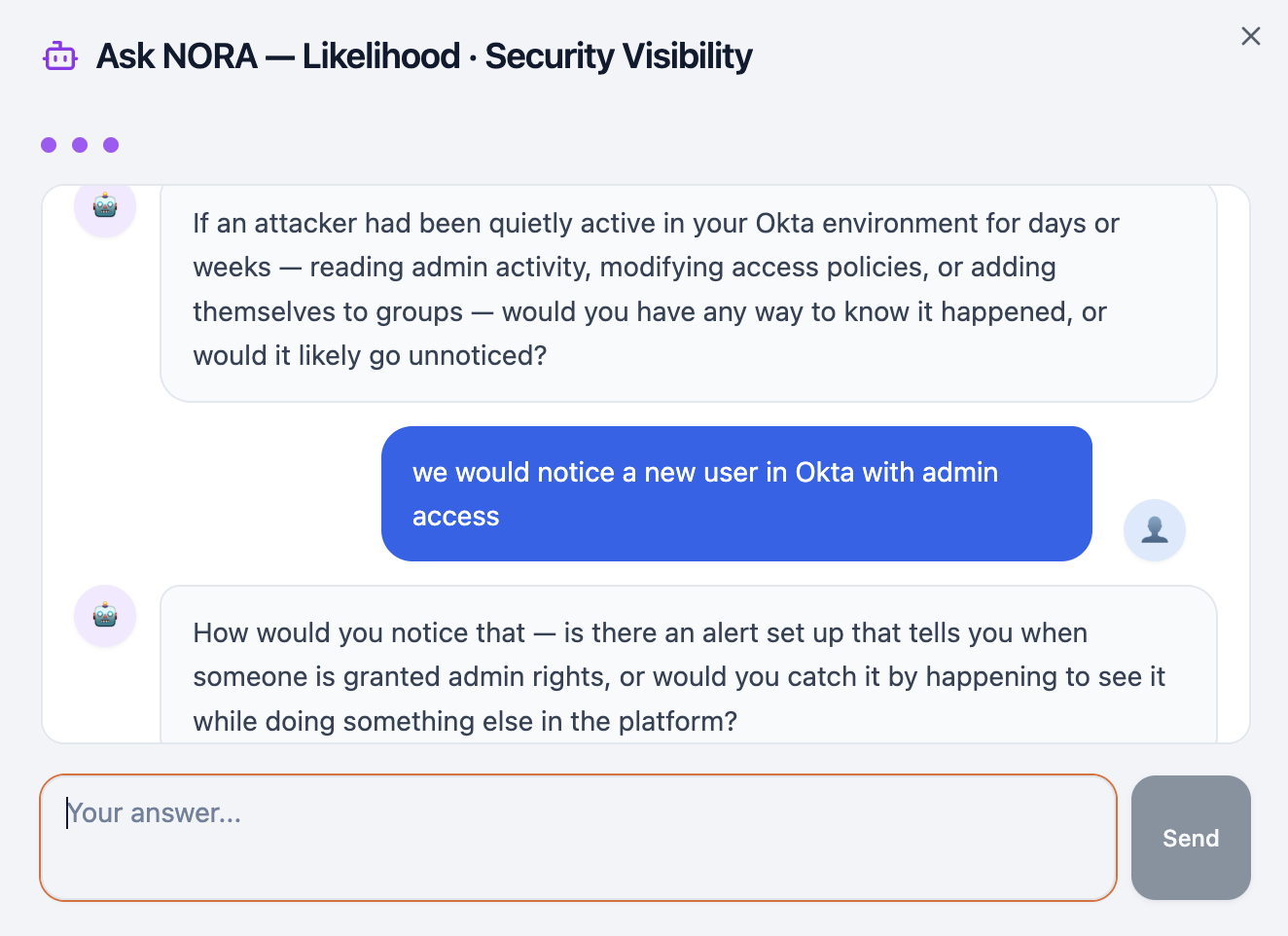
The real conversation: NORA asks in plain English, the asset owner answers in their own words — and every answer becomes defensible, scored risk.
Real Breaches, Matched to Your Stack.
NORA brings sourced incident history for the actual products you run into the assessment — so the conversation reflects how systems like yours have really been attacked, not a generic checklist. Every reference traces back to its source.
Files uploaded to Okta's support portal exposed session tokens, letting attackers reach several customers' environments.
Accounts without multi-factor authentication were accessed with stolen credentials, exposing large volumes of customer data.
A flaw in the MOVEit file-transfer tool was mass-exploited, exposing data from hundreds of organizations.
Inside NORA
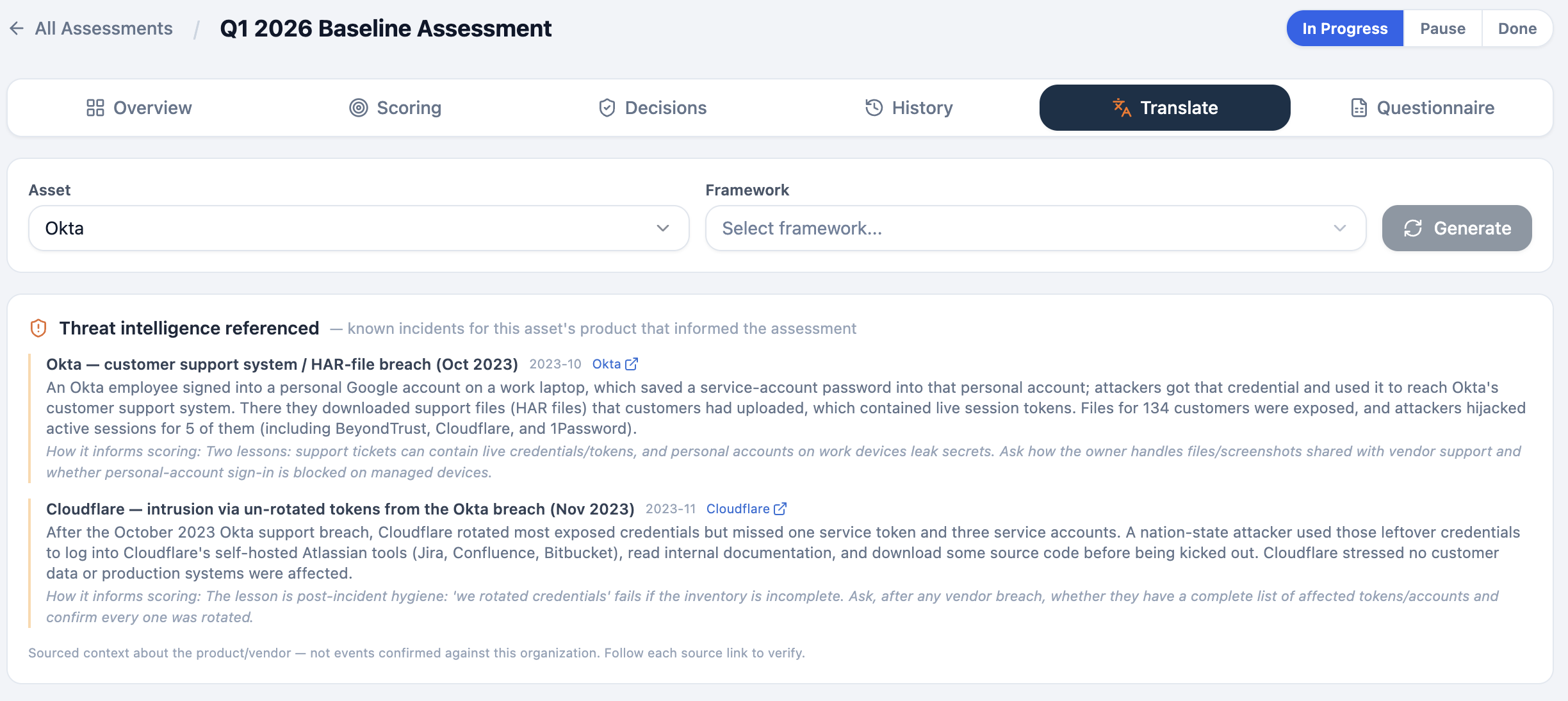
The same sourced incidents, surfaced inside the assessment for the products you run — each with how it informs the scoring.
Every card is curated and reviewed by a practitioner, matched to your assets by product, and surfaced with its primary source. NORA brings context, not noise — and never scans your systems.
When the Audit — or the Questionnaire — Arrives,
You're Not Starting From Scratch.
Everything your owners tell NORA becomes a living, sourced record of your risk. So when an auditor's request or a customer's security questionnaire lands, you're reviewing answers that already exist — not starting from a blank page.
A Living Risk Record
Every assessment adds to a current picture of what you run, how it's controlled, and where the risk sits.
Answers Already in Your Words
When a request comes in, the relevant responses are already there — organized, sourced, and consistent across your systems.
You Review and Own It
NORA assembles what your business already knows. You review, finalize, and stand behind every answer — the sign-off stays with you.
A Practitioner's Judgment, Built Into Every Assessment.
NORA isn't a generic questionnaire engine. It encodes how an experienced practitioner actually assesses a system — which questions matter for this kind of app, how much to trust an unconfirmed control, how it maps to a framework — and applies that judgment identically across every assessment. The expertise is built in; the technology just delivers it consistently.
Same Method · Every Asset · Every Time